



In just a few days, Camunda 7 Community Edition will officially reach its end of life. For many companies, this raises a difficult question: ➡️ Should we migrate to Camunda 8, or look for another way forward?
Over the past months, I’ve had many discussions with teams facing this situation. And the feedback is often similar : migrating to Camunda 8 isn’t a simple upgrade. It means major refactoring, new infrastructure, and a significant investment in both time and resources.
Having spent 6 years as a Solution Architect at Carrefour, designing and maintaining large-scale orchestration systems based on Camunda, I know exactly what this means in practice.
That’s why, at Code Once, we chose a different path, to help our clients move forward without the pain of migration.
OrqueIO — the natural successor to Camunda 7
Over the last few months, our team has achieved something remarkable: we’ve built OrqueIO, a modern, long-term supported fork of Camunda 7 that allows organizations to keep their existing architecture — without the heavy migration effort.
With OrqueIO, you simply continue running your processes as before, but on a renewed foundation :
- Java 25 & Spring Boot 4
- Full compatibility with existing Camunda 7 models and APIs
- Continuous improvements and regular security scans
- Free and open-source, with optional enterprise support
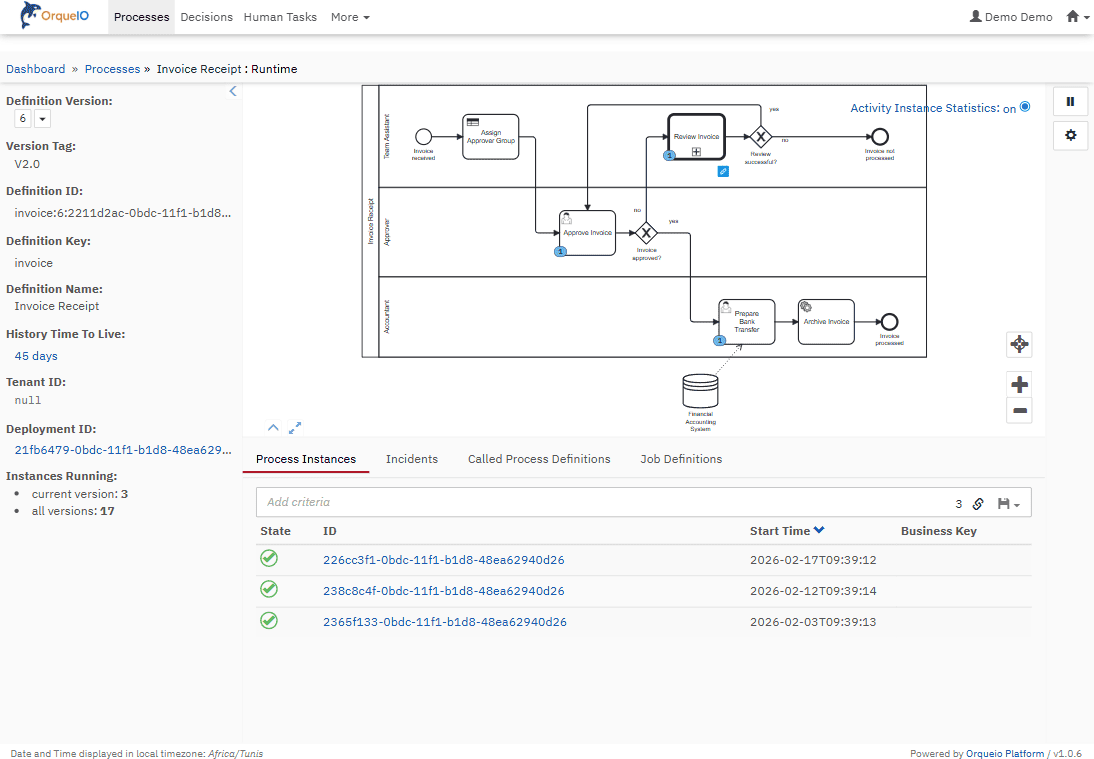
Here’s a first look at the OrqueIO interface — modern, clean, and 100% compatible with Camunda 7 environments.
Built in France, Close to the Ecosystem
What makes OrqueIO special is not only its technology, but also its roots. It’s a French open-source initiative, created by engineers who’ve spent years working with Camunda in real enterprise contexts.
That local proximity makes a difference. We understand the challenges of French and European organizations, their constraints, and the importance of reliable, transparent solutions.
What’s Next?
Camunda 7 may be coming to an end, but the open-source journey is far from over. With OrqueIO, we’re continuing the story — modern, compatible, and community-driven.
And the best part: in just a few days, we’ll be hosting an online event with the official presentation of OrqueIO. It will be a great opportunity to discover the platform, meet the team, and learn more about what’s coming next.
Our roadmap already includes a number of enterprise-grade features designed to make orchestration smarter, simpler, and more secure:
- Single Sign-On (SSO) and centralized access management
- Built-in documentation and model insights directly in the UI
- AI-powered optimization for performance and monitoring suggestions
- Enhanced observability and analytics dashboards
- Improved developer experience with CLI tools and simplified deployment
All these improvements will be released gradually, staying true to our core principle: keep compatibility, add value.
Related reading: Why OrqueIO among all Camunda 7 forks in 2026? · Camunda 7 end of life: what comes next?
Join the OrqueIO community
Follow our updates, chat with the team, and ask your questions.