




Introduction
In today’s distributed systems landscape, microservices have transformed the way we design and scale software. Yet with this flexibility comes new layers of complexity. As organizations embrace service-based architectures, orchestrating workflows efficiently across independent services becomes both a technical challenge and a strategic necessity. Without proper structure, even advanced systems can quickly fall into disarray, with tangled dependencies, inconsistent data flows, and fragile integrations that struggle under real-world pressure.
This is where OrqueIO makes a difference. It provides a powerful orchestration platform designed to bring clarity, reliability, and control to complex microservices ecosystems. However, success with orchestration does not depend solely on the platform itself but on how it is used. Applying the right design practices turns orchestration from a simple connector of services into a scalable and intelligent engine that drives business value.
In this article, we explore several best practices that help teams build effective, maintainable, and future-ready orchestrations with OrqueIO. We begin by emphasizing the importance of thinking business first, ensuring that workflows are grounded in clear business logic before implementation. We then discuss how separating concerns through domain-driven design helps keep microservices clean and independent. Next, we explore how asynchronous execution enhances scalability and resilience by decoupling workflow execution into smaller, reliable units. Finally, we cover the importance of versioning and migration strategies that allow workflows to evolve safely without disrupting ongoing operations.
Each of these practices is grounded in real-world experience and aims to help teams design systems that are not only functional but also resilient, maintainable, and adaptable. Whether you are just getting started or optimizing existing workflows, these principles will help you harness the full potential of OrqueIO and orchestrate with confidence.
1. Think Business First: Define Models Before Workflows
Before building any workflow in OrqueIO, the first best practice is to start with the business, not the tool.
Successful orchestration depends on a deep understanding of the business model, its entities, and its objectives — before translating them into BPMN.
When teams define what the process is supposed to achieve and which business objects it manipulates, their workflows become cleaner, more logical, and easier to maintain.
This avoids the “technical spaghetti” effect that comes from designing BPMN diagrams without business clarity.
Example — Simple Order Processing
Let’s say you’re building a simple Order Process in an e-commerce system.
Before designing the workflow in OrqueIO, you start by defining the business model:
Entity: Order
Attributes: orderId, customerId, amount, paymentStatus
Business rule: An order can only be confirmed if the payment is successfully verified.
Once this business logic is clear, the BPMN process becomes straightforward:
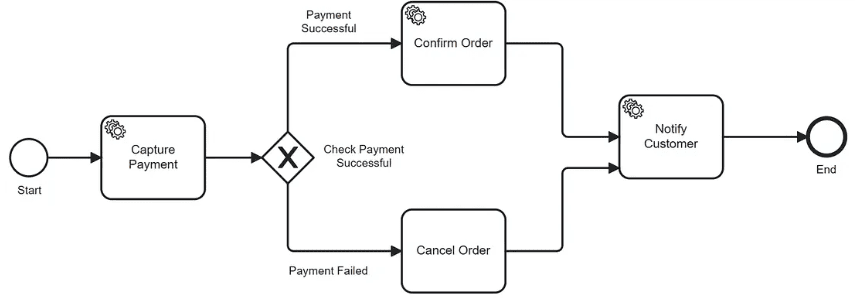
Because the rule is defined at the business level, the workflow is intuitive, testable, and easy to extend (for example, by adding refund logic or payment retries later).
When business rules guide your design, OrqueIO workflows stay meaningful and aligned with real-world operations — not just technical flows.
2. Separate Concerns: Focus on Domain, Not Orchestration
When integrating OrqueIO into your microservices, one of the most important principles is to separate orchestration from business logic.
Each microservice should focus solely on its own domain responsibilities, while OrqueIO handles the workflow coordination between them.
Subscribe to the Medium newsletter
For example, in the same Order Process we discussed earlier:
- The Payment Service is responsible for verifying the payment and updating its own status .
- The Order Service manages the order’s lifecycle.
- OrqueIO orchestrates how they interact, defining when to trigger the payment verification and what happens next depending on the result.
In this setup, OrqueIO never contains business rules like how payments are verified or how orders are stored . It simply coordinates their execution.
This separation ensures that domain services remain autonomous and reusable, while OrqueIO focuses on process logic.
It also makes maintenance easier: you can evolve payment logic or add fraud checks without touching the orchestration layer.
In short, OrqueIO orchestrates — it doesn’t operate. Let each microservice own its business logic.
3. Scale Smarter with Asynchronous Workflows in OrqueIO
In modern microservices architectures, efficient workflow orchestration is essential. OrqueIO enables this through asynchronous execution, letting you split workflows into smaller, independent transactions. Each task can be committed separately, processed in parallel, and even distributed across multiple nodes — like a production line where multiple workers handle different stages simultaneously.
Using our Order Process example, marking the “Check Payment Successful” task as asynchronous allows OrqueIO to handle multiple orders in parallel. While one order’s payment is being verified, other orders can be processed independently, boosting throughput and reducing bottlenecks:
Beyond performance, asynchronous boundaries enhance resilience. If a single payment verification fails, only that transaction is retried, other orders continue unaffected. This isolation prevents cascading failures and ensures predictable execution across high-volume workflows.
By leveraging asynchronous tasks in OrqueIO, teams can design workflows that are robust, fault-tolerant, and highly scalable, perfectly suited for real-world e-commerce operations where speed, reliability, and adaptability are critical.
4. Maintain Control with Versioning & Migration
In complex microservices ecosystems, workflows evolve constantly, and managing changes without disrupting live processes is critical. OrqueIO provides tools to maintain multiple workflow versions and handle migration safely, allowing teams to introduce updates, test new logic, and gradually migrate running instances.
By keeping active workflows on their original version while new instances use updated logic, teams can prevent unexpected behavior, reduce operational risks, and maintain system stability. Automated migration paths further ensure smooth transitions and consistent orchestration across environments.
Example: Updating Payment Logic in Order Process
Suppose you want to enhance the Order Process with a fraud check during payment verification:
- Original workflow: Payment verification only checks for sufficient balance.
- Updated workflow: Payment verification now includes a fraud check.
With OrqueIO versioning:
- Orders already in progress continue with the original workflow.
- New orders use the updated workflow with fraud detection.
This ensures that running orders are unaffected while new business rules are applied safely. Versioning and controlled migration make workflows adaptable, testable, and maintainable over time.
Conclusion
Effective orchestration of microservices requires more than just technical implementation — it demands a strategic, business-aware approach. By thinking business first, separating concerns, leveraging asynchronous workflows, and carefully managing versioning and migration, teams can build scalable, resilient, and maintainable systems with OrqueIO.
These best practices not only improve workflow performance but also enhance the adaptability of microservices architectures, allowing organizations to respond quickly to evolving requirements and high-volume workloads. When applied consistently, they transform OrqueIO into a powerful engine for operational excellence, enabling organizations to automate complex processes while maintaining control, reliability, and agility in real-world environments.
Join the OrqueIO community
Follow our updates, chat with the team, and ask your questions.